Somewhere along the way, my husband and I decided we’d rather spend our money on new places than on stuff. This is how we ended up wandering a walled historic city with a questionable number of bones for our anniversary. Évora is a small city in Portugal’s Alentejo region. It was designated as a UNESCO World Heritage City in 1986, so it is full of really interesting history. It’s also just an easy 2.5-hour drive from Tavira. I stopped here for a quick lunch during a road trip this summer, but I wanted to spend more time, so it seemed like a perfect place for a quick getaway. From a Royal Palace to bones to great food, Évora is a great place to explore if you are in Portugal. Here’s how we did Évora in 24 hours.
Quick Facts
Getting to Évora
The easiest way to get to Évora from the Algarve is driving. There are 2 routes: one takes you on toll roads and busy highways. The other is a slower route through the Portuguese countryside. We chose the latter. Both take about the same amount of time, so pick your vibe. (In my Smart ForTwo, I prefer to stay off the busy highways)
From Lisbon, you can take a train, bus, or drive, and it will take about 1.5-2 hours.
Where We Stayed
We rented a small apartment in the city on Booking for €95. There are also hotels, but most seem to be just outside the city walls. They still are within walking distance to the centro. Bonus points: this one wasn’t haunted (read about my haunted apartment in Cordoba here)
Gluten-Free in Évora: What I Ate and How It Went
I have celiac disease, so I used the Find Me Gluten Free app to find options, and there were plenty to choose from. As always, I asked staff at each spot what was safe for celiacs. I felt fine afterward everywhere. Here’s the rundown:
- Ebora Cafe: My first stop for coffee. They did not have any gluten-free food options.
- Alentejo Natural: A natural food store near the cafe where I grabbed a couple of gluten-free snacks.
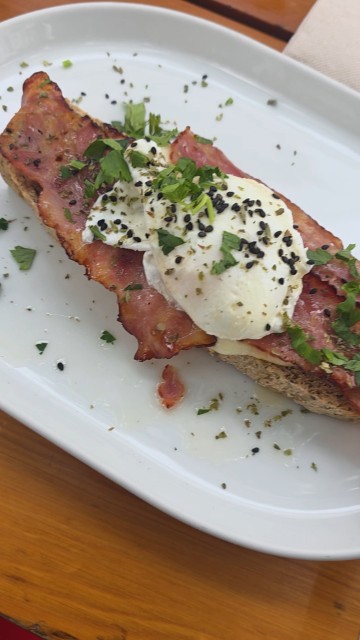
- Do Largo: Breakfast with gluten-free, vegan, and lactose-free options. I had gluten-free toast with bacon, egg, cheese, and honey.
- Jimbu: Lots of gluten-free options, plus vegetarian and vegan dishes. The lamb korma and pork sekuwa were my favorites.
- Magnifica Beer House: They had bottled Somersby cider, which worked for me. Craft beer isn’t an option if you’re celiac, but your beer-loving travel buddy will be happy.
Best time to visit
Spring and early fall are the best times to visit Évora for the best weather. The summers get VERY hot. Winters are rainy and colder, but there are also fewer tourists at the different sites. I went the 2nd weekend of October, and it was nice. It wasn’t very busy, and the temperature was warm during the day and slightly cool in the evening.
Évora in 24 Hours: Our Itinerary.
There are so many amazing, historical sites to visit in Évora. Luckily, the town isn’t very large, and it’s super walkable. You can get a lot done in a short amount of time without feeling like you did too much.
We arrived in Évora right around 12 pm, and our first stop was coffee. I’m not exactly a morning person, so I needed caffeine before we could do anything. We found a little cafe, and nearby was a natural food store, so I could grab a couple of gluten-free snacks. Once I was caffeinated, we started to explore.
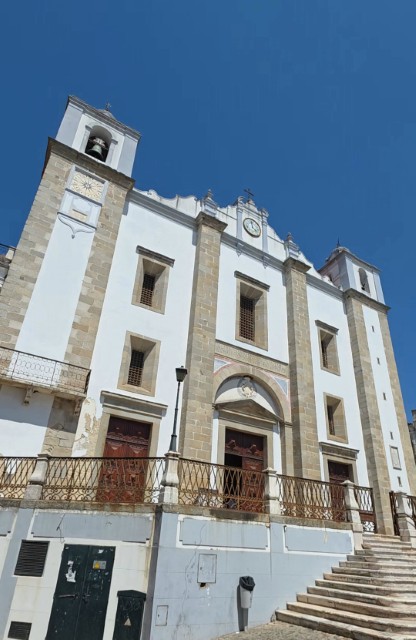
We started just walking through town. Évora is really pretty to wander through, and our wandering took us through the Praça do Giraldo, the main square in the historic centro. It’s surrounded by shops and restaurants. It’s a good place to get your bearings, grab a snack, or just people-watch. The white church on the square is Igreja de Santo Antão. It was built in the 16th century in the Renaissance style, and its interior includes a painting called “Souls,” attributed to Évora born artist Jerónimo Corte Real.
Our goal was to walk to the amazing gluten-free pizza restaurant I had eaten at before so we could make a dinner reservation. Unfortunately, the restaurant no longer existed, so we had to change our plans; more on that later. Instead, we stopped for a nice glass of sangria.
Igreja de São Francisco de Évora and the Capela dos Ossos (The Chapel of Bones)
This was our first stop because it was actually somewhere I had wanted to visit before I moved here when I saw it on Instagram during my research. The Church of St. Francis dates back to the late 1400s and early 1500s, and the Chapel of Bones was added later in the 17th century.
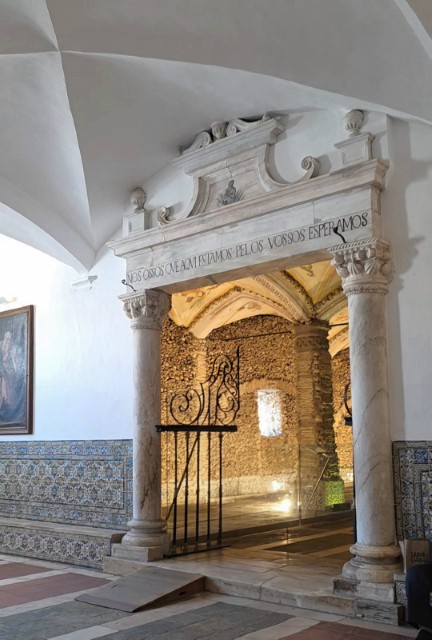
The Chapel of Bones is a small chapel attached to the larger St. Francis church, and it is one of Portugal’s most hauntingly unforgettable landmarks. The friars who built this chapel wanted visitors to remember that life is short, and they made the point by covering the walls and pillars with bones. Thousands of them, collected from Évora’s crowded old cemeteries and churches. Before you even step across the threshold, a stone inscription sets the tone with a chilling greeting: “Nós ossos que aqui estamos pelos vossos esperamos” (“We bones that are here, for yours we wait”).
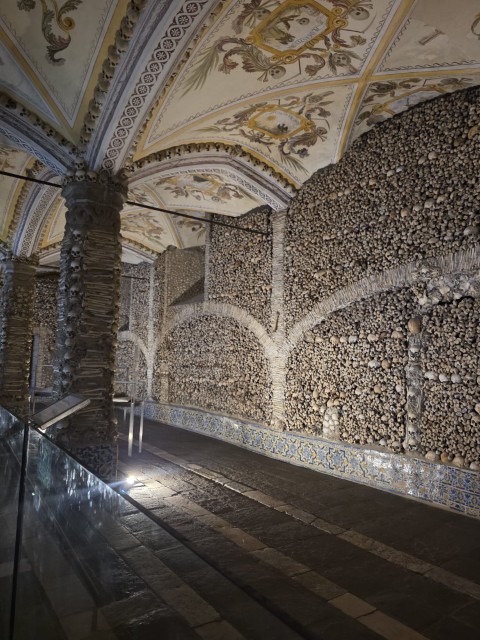
Off to the side of the aisle, an adult and a young child rest mummified in glass cases. They used to hang from the walls on chains, but were placed in glass coffins possibly in 2019. Nobody really knows who they were. All that’s certain is that they’ve been in the chapel since the 17th century. One legend says the man was an adulterer and the child his sinful offspring. Another says they were a woman and her child who were cursed and refused burial.
Entrance to the main church is free, but entry to the Chapel of Bones costs €7 for adults. You also get access to the Chapter Room and Évora Nativity Scene, the Museum Center of Sacred Art and the Royal Tribune Room, Galilee Terrace and the Canha da Silva Nativity Scene Collection. The nativity scene collection was also really cool; there were nativity sets from all over the world. Galilee Terrace also has a decent view of the city, the Royal Palace, and the Gardens.
Hours are 9 -6:30 in the summer and 9-5:00 in the winter.
Royal Palace and Garden
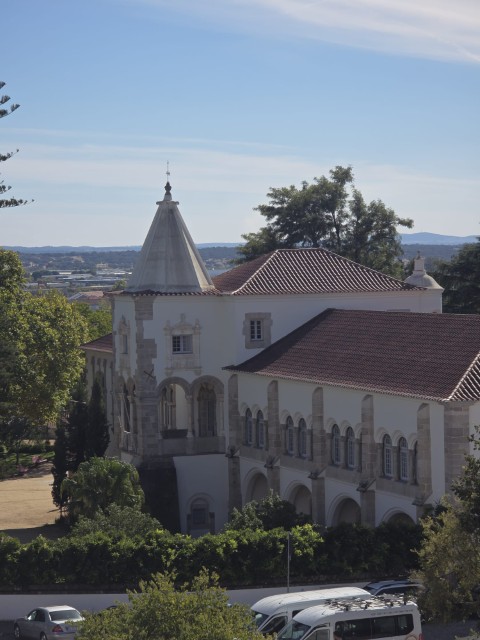
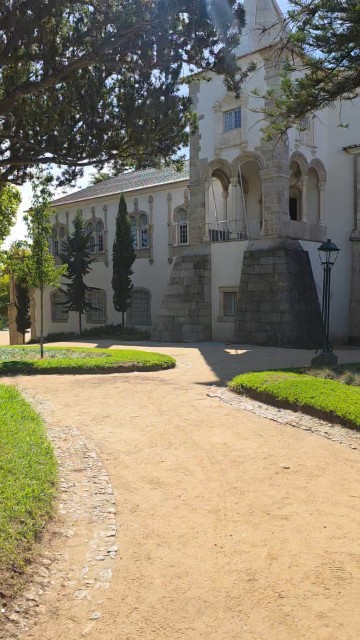
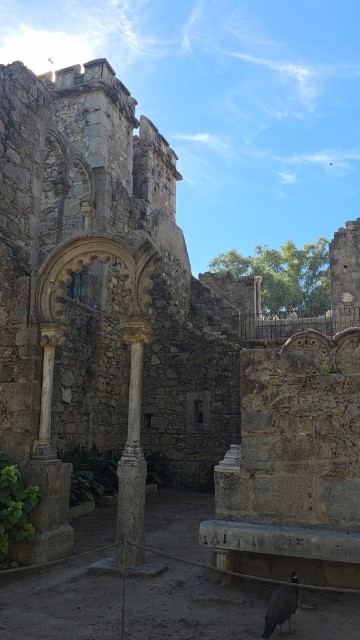
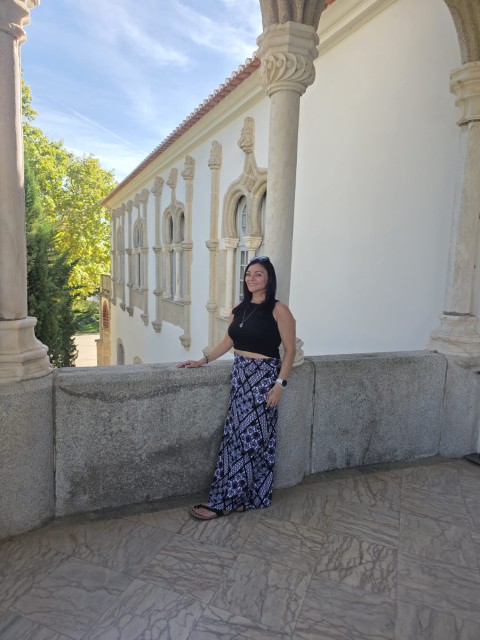
Right next to the Church of St. Francis, tucked inside Évora’s lush Public Garden, you’ll find the Royal Palace of Évora (Palácio de Dom Manuel), and it’s completely free to wander through. Most of the massive 15th-century royal complex is long gone, but the surviving wing, the Ladies’ Gallery (Galeria das Damas), is a gorgeous mix of Gothic, Manueline, Renaissance, and Moorish-inspired arches.
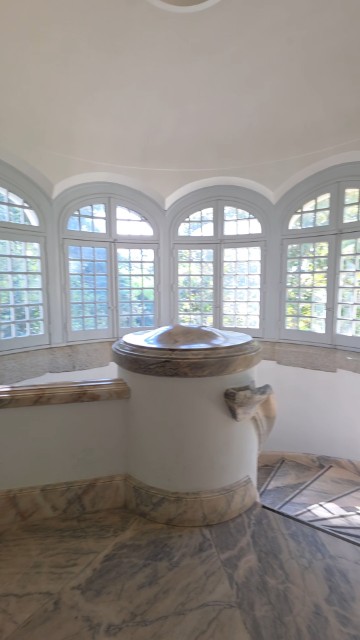
Inside, the ground floor houses the Évora City Interpretive Center, where scale models, interactive maps, and bilingual displays walk you through the city’s story from its Roman roots to today and show exactly why the entire town was named a UNESCO World Heritage Site. A stunning marble staircase takes you upstairs to the bright upper gallery, which showcases rotating local art and photography, and a veranda overlooks the gardens. It’s a quick, easy stop, but it makes everything else in Évora hit differently once you know how much history is here. The palace is also believed to be where Manuel I put Vasco da Gama in command of the fleet headed for India, so yes, you’re standing in a very big moment in history.
Évora Public Garden (Jardim Público de Évora)
After the heaviness of the Chapel of Bones, the Évora Public Garden (Jardim Público de Évora) was exactly what I needed. It wraps around the Royal Palace, and it’s a lush, 19th-century Romantic park built on the former orchards and gardens of the palace and convent. It was designed in the 1860s by Italian architect and theater set designer Giuseppe Cinatti, which shows in the scenic stage sets, with winding paths, exotic trees, shaded woodland trails, a classic iron bandstand, and views of Évora’s 14th-century medieval city walls. In the back of the garden are the Ruínas Fingidas (“Fake Ruins”), a faux medieval tower built from salvaged Gothic windows and stonework from demolished local monuments.
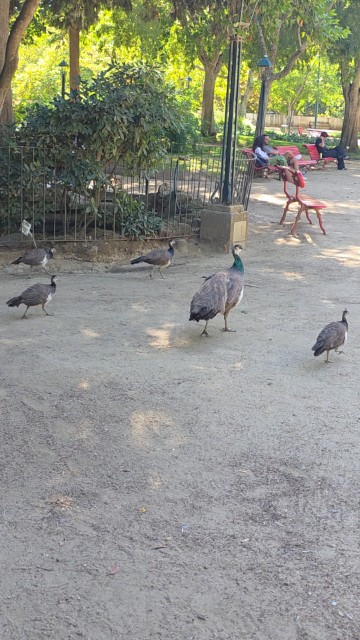
The garden has tons of free-roaming peacocks, which my husband tried to befriend, and ducks swimming in multiple ponds. This garden is a beautiful, picturesque place to grab a cup of coffee at the kiosk, have a picnic under the trees, or relax on one of the benches while you people-watch and take in the beauty around you.
Magnifica Beer House
After the palace and gardens, it was time for a break from sightseeing. Just a short walk away was Magnifica Beer House. My husband loves craft beer, so we usually try to find a cool brewery or tap house wherever we go. They had a good selection of craft beer, which isn’t easy to find in Portugal; the craft beer scene here is still small. I got a Somersby cider, which is always nice and refreshing. The vibe here was really cool, and there was fun art painted on the wall. We actually even came back here after dinner so my husband could try some more of the beers.
Checked into the Apartment
It was time to check into our apartment. I found this cute apartment near the city center. It was a nice 1-bedroom, and they even left us a bottle of local wine. The apartment was clean, modern, and comfortable, and perfect for 1 night. We took a nap for a while, since it had already been a pretty long day, and then got ready for dinner. The apartment was €95 a night.
Dinner dilemma and wine stop
So since our original plan for pizza was sadly squashed, we had to find another place to eat. I found a few options on the Find Me Gluten Free app, and we figured we would just head out to dinner whenever we were ready. Well, that was a mistake. All of the restaurants we had chosen were full! We definitely needed a reservation. We sat at a wine bar and had a glass of wine while I searched for another option. I was a bit hangry by this point and annoyed with myself for not planning better; however, it actually turned out better than I expected.
Dinner at Jimbu
While searching for a restaurant, I came across Jimbu, a Nepalese restaurant. I had tried a bit of Nepalese food in Castelo Branco, and I wanted more. They didn’t have any reservations for an hour, and I was so hungry, so we decided to take a chance and walk over. We got lucky, and we were able to get a table!
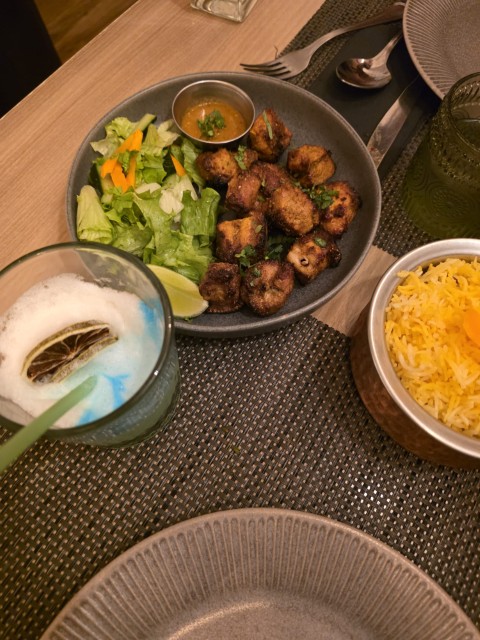
The name Jimbu comes from an herb that grows in the Himalayas, and they use it in their amazing dishes. To start, we each had a delicious cocktail made with poejo, an herb grown in Portugal. It was minty, sweet, and so good. It actually reminded me of the Christmas mints I used to make with my mom and sister growing up. We shared a few different dishes, and everything was incredible. They had many gluten-free options as well as vegetarian and vegan dishes. Everything was so good, but my favorites were the lamb korma, the pork sekuwa, and the dessert! We shared the Doce de cenoura, which was a panna cotta with cardamom and carrot. It was seriously delicious! Dinner here, with 2 cocktails, appetizers, a meal, dessert, and a glass of wine, was €70 and absolutely worth every penny.
Breakfast at Do Largo
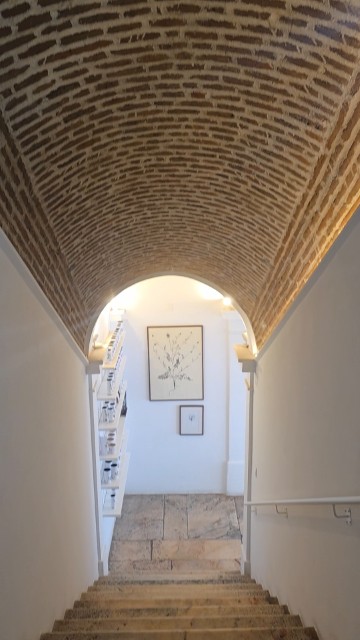
We started our morning with a delicious breakfast at Do Largo. It was a super cute restaurant with options for gluten-free, vegan, and lactose-free diets. The food is super fresh because they make everything in-house. They source their ingredients from their own organic garden and from local producers. They also sell some of their products, as well as local wine and jams in their shop. The place itself is really cool, with a stone archway and the architecture of the historic building. It was a great find!
Some more sightseeing
Cathedral of Évora
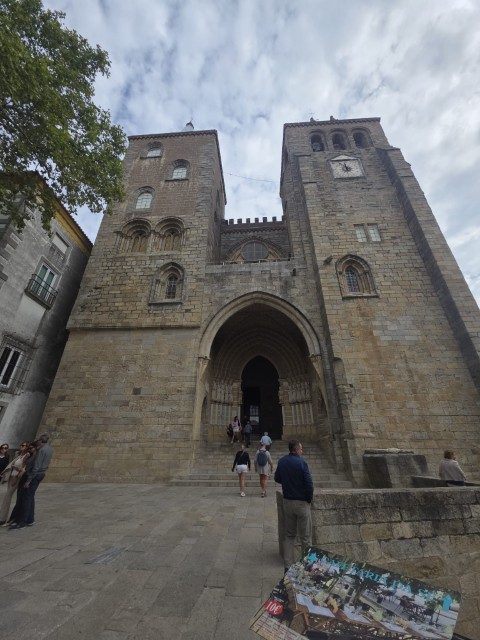
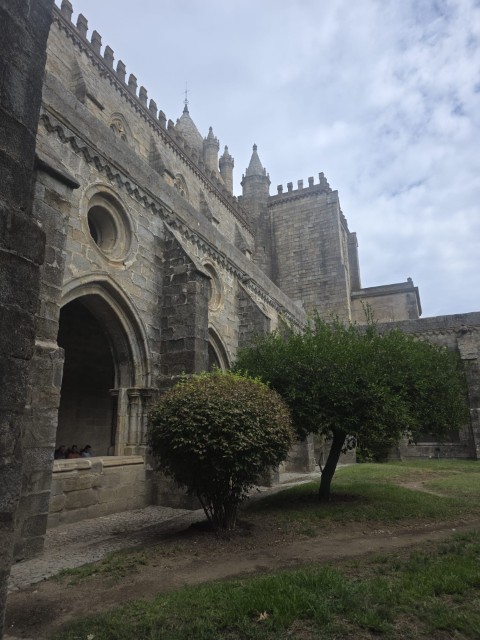
After breakfast, we walked over to the cathedral. Évora Cathedral (Sé Catedral de Évora.) Built mainly between the late 12th and 13th centuries, it looks more like a granite fortress than a traditional church. Its heavy Romanesque Gothic facade is flanked by two massive, mismatched towers, one with a conical spire and the other a tiled bell tower, and twelve carved stone apostles keep watch at the portal.
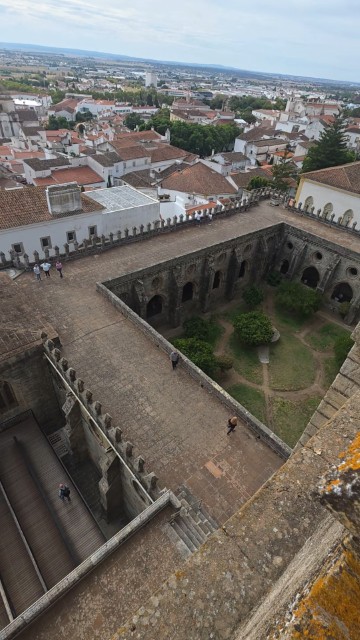
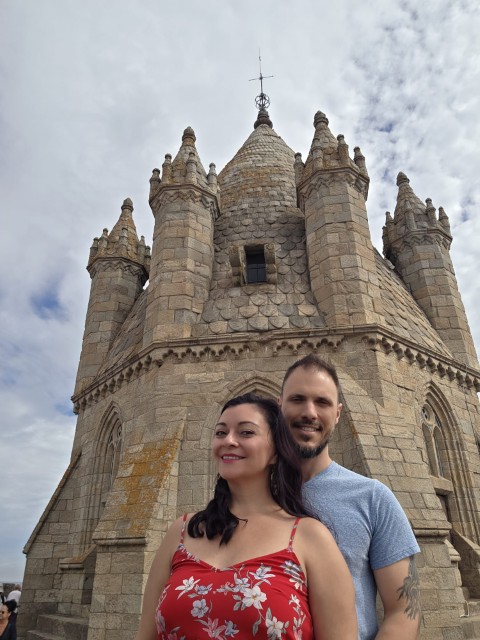
Inside, the soaring interior leads to a serene Gothic cloister and an impressive sacred art museum. The real highlight, though, was climbing the narrow stone spiral staircase to the rooftop terrace. It was a bit tiring to climb all those stairs, but it was so worth it. Walking along the open-air stone ramparts, I got panoramic, 360-degree views over Évora’s whitewashed houses, terracotta rooftops, and the Alentejo plains, and it’s easily the best vantage point in the city. Admission is €5, and it’s open from 9-5 every day. The ticket also gives you entry to the Évora museum. Unfortunately, we didn’t get to go to the museum because it closed at 1 pm for lunch, and we needed to head back to Tavira.
Roman Temple
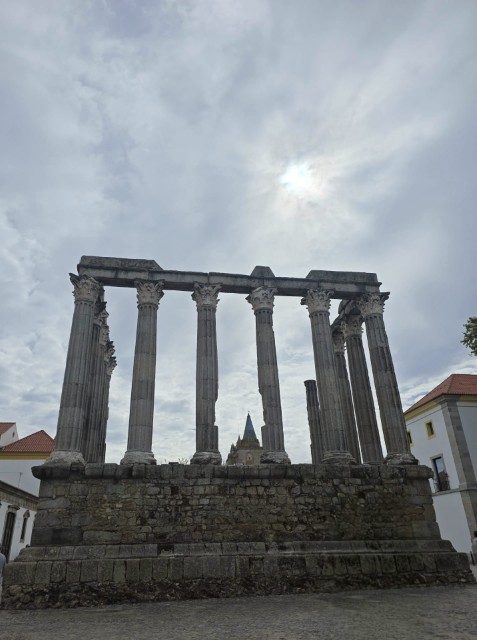
Right outside the museum is the Roman Temple. The Roman Temple of Évora is one of those spots where you can feel how old this city really is. Built around the 1st century AD, when Évora was called Liberalitas Julia, it’s often called the Temple of Diana, but it probably wasn’t dedicated to her at all, and was more likely built to honor Emperor Augustus.
It was originally part of the Roman forum, and its Corinthian columns still stand on a stone base in the middle of town. It hasn’t had a quiet life, though; it was folded into Évora’s castle in the Middle Ages, and it served as a slaughterhouse until 1870. You can walk around it any time of day, and it’s lit up at night. Right beside the temple are a couple of gardens where you can get some more views of the countryside and have a break from walking around the town.
What I missed
There were a few more things I had wanted to do, but we unfortunately did not get to do them. Had we stayed another night, we would have definitely done them.
Museu Nacional Frei Manuel do Cenáculo
The one I was most bummed about was the Évora Museum, which closed at 1 pm for lunch right before we needed to head back to Tavira. Officially, it’s the Museu Nacional Frei Manuel do Cenáculo, and it holds more than 20,000 pieces across painting, archaeology, sculpture, and decorative arts. It’s in the former archbishop’s palace, right next to the cathedral, and the cloistered courtyard shows off Islamic, Roman, and medieval remains. The star of the show is supposedly the Life of the Virgin, a series of 13 panels from the cathedral’s old altarpiece, painted by anonymous Flemish artists working in Portugal around 1500. It was included with our cathedral ticket, which makes missing it sting even more, but it’s another reason for a return trip.
Almendres Cromlech
Another thing we didn’t get to see, but really wanted to, was the Almendres Cromlech, a set of prehistoric standing stones just outside Évora. It’s the largest group of structured standing stones on the Iberian Peninsula and one of the largest in Europe, and it’s thought to be older than Stonehenge. There’s no public transport out there, so you’ll need a car or a guided tour. Since it was out of the way on our drive back to Tavira, we had to skip it this time, but it’s already at the top of the list for our next trip.
The Wineries
We also ran out of time for the wineries around Évora, which hurt a little. Three in particular were on my list, and each takes a totally different approach to Alentejo wine. At Fitapreta, winemaker António Maçanita pairs avant-garde winemaking and clay amphora (talha) fermentations with a restored 14th-century medieval palace, Paço do Morgado de Oliveira, plus a contemporary cork-clad cellar. Cartuxa (Quinta de Valbom) sits right next to a 16th-century Carthusian monastery on a historic former Jesuit estate, where you can tour the traditional cellars and taste iconic labels like Pêra-Manca. And Herdade do Freixo in Redondo has a spiral winery built entirely underground beneath the vineyards. It’s said to be the only fully underground winery in Europe; it uses gravity in the winemaking, and the temperatures stay naturally constant. Next time, we’re making room for at least one.
The Dark Sky Alqueva Reserve
The thing I most wish we’d had time for was stargazing. The Dark Sky Alqueva Reserve is a short drive from Évora, and it was certified in 2011 as the first Starlight Tourism Destination in the world. It’s supposed to have some of the clearest, most unpolluted night skies in Europe, and it covers more than 10,000 square kilometers around Lake Alqueva. The region protects the darkness by having surrounding towns dim their public lighting after dusk, so on a clear night you can see the Milky Way, constellations, and shooting stars with the naked eye. You can book a guided telescope session with local astronomers at the Official Dark Sky Alqueva Observatory in the village of Cumeada, or at the Lake Alqueva Astronomical Observatory (OLA) just below the medieval hilltop village of Monsaraz. I definitely want to do this next time; I think it sounds incredible.
Wrapping Up 24 hours in Évora
Évora is a charming town with so much history! It still boggles my mind to think how far back all these places go. It feels so crazy to think how hundreds of years ago people wandered these same streets and how different life is now. If you are interested in history and architecture, Évora is definitely a place to visit in Portugal. I think it was a very special place to celebrate our anniversary, and I would definitely recommend it to anyone visiting Portugal.
Tips for Visiting Évora
- Make dinner reservations! Restaurants are small, and tables fill up fast.
- Be mindful of business hours. We missed the museum because they close daily for lunch.
- Wear good walking shoes; the sites are all walkable, but the streets are cobblestone and can be slippery.
- Try the local wines! Alentejo makes amazing red wines.
Read More
To read about what life is like living in the Algarve, read these posts here.
If you’re curious about how I moved to Portugal, check out these posts.
Follow Me
For more about my life in Portugal, traveling around Europe, and more day-to-day content, check out my social media channels. I am on Instagram @vegas.to.portugal and TikTok @expat.in.portugal. 💙